

Evolved Stars
We till retain a strong research group in late stage stellar evolution as the remaining major astrophysics interests of the LSR despite our pivot to Space Sustainability, Space missions and the NewSpace economy. This focus, where we are currently ranked 8th globally (according to SciVal metrics) is based around our hosting the world leading “Hong Kong AAO Strasbourg H-alpha Planetary Nebulae Research Platform” (HASH). This is a fully integrated SQL database (see website hashpn.space) for essential, up-to date information for all known Galactic planetary nebulae (PNe) and used by over 1140 registered users from more than 250 universities, institutes and affiliations from 68 countries as in our 2025 annual report. With the HASH interface, users can sift, select, browse, collate, investigate, download and visualise the entire currently known Galactic PNe diversity. HASH provides the community with the most complete and reliable data with which to undertake new science.
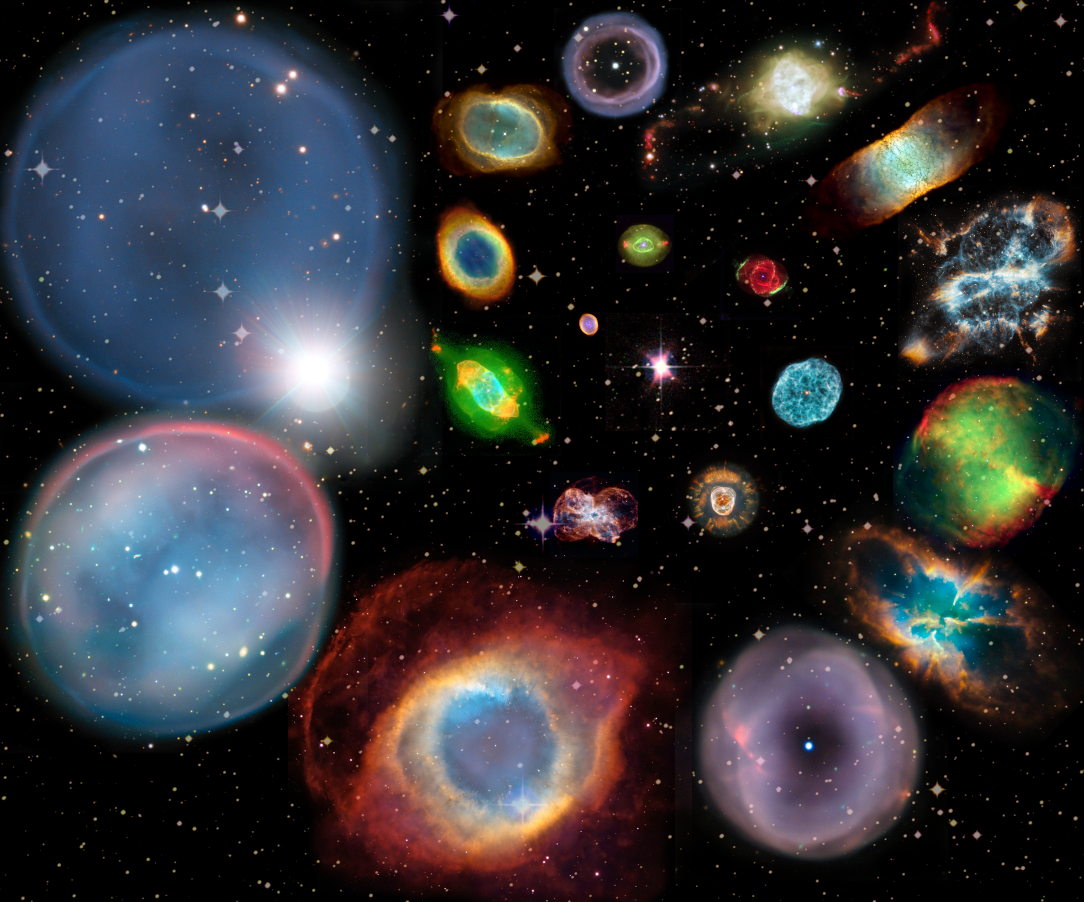
Our research concerns the observational and theoretical issues around the short phases of stellar evolution whose various pathways are strongly dictated by the stellar birth mass. Low to immediate mass stars with less than about 8 times that of our Sun will pass through a so called Planetary Nebula (PNe) phase. This is where a final stellar envelope ejection of material, after the post-AGB phase, will be ionized by the hot, contracting stellar core on its way to becoming a White Dwarf. The ejected shroud glows with a rich emission line spectrum to reveal a bewildering variety of colourful and majestic forms that we call PNe.
Under the prior leadership of previous director Prof Sun Kwok (now an emeritus professor and LSR affiliate) and now current director Prof Quentin Parker, a strong and highly productive PNe and post-AGB star research group of faculty, postdoctoral fellows and RPG students has been established. A series of highly influential papers have been produced.
Members: Quentin Parker, Andreas Ritter, SeyedAbdolreza Sadjadi, Haoyuang Yuan and Zhengjie Tian